
How to Castle in Chess: A Beginner’s Guide
Castling is one of the special moves in chess. It is the only move that lets you move two pieces, the king and a rook, as part of a single move.
There are two types of castling: kingside castling and queenside castling. This guide shows how each move works and explains the rules that determine when you can and cannot castle.
If you’re brand new to the board, start with how to set up a chessboard first, then come back to this lesson.
Castling at a Glance
To castle, move the king two squares toward the rook, then move that rook to the square immediately on the other side of the king.
- The king must not have moved earlier in the game.
- The rook used for castling must not have moved earlier in the game.
- The king cannot be in check.
- The king cannot castle into check.
- The king cannot castle through a square that is under attack.
How to Castle Kingside
Okay, we’ve seen kingside castling before. And yes, there’s a
queenside castling (castling in the opposite direction with the other rook) as
well. So let’s look at the particulars of castling. We’ll set up a king and a
rook on the board by themselves.
Here we have the king and rook sitting on |


Step 1: Move the King Two Squares
The first half of castling involves moving the king:
|
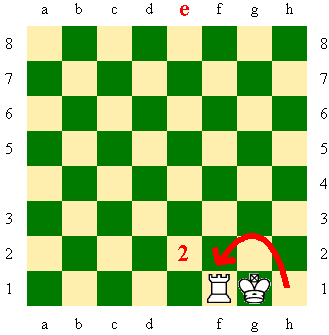
Step 1: The white king moves TWO squares towards the rook with which it intends to castle. This is the only time in the game a king gets to move more than one square at a time. |


Step 2: Move the Rook
And for the second half of the move, the rook goes around to
the other side.
|
|
Step 2: The rook hops over the king and takes its place on the other side of His Majesty, sitting on the square right next to him.
|
How to Castle Queenside
Now we’ve gone over kingside castling, which involves the king
and the rook nearest to it on the right side of the board. But you’ve got two
rooks, haven’t you? The other rook is on what we call the ‘queenside’ of the
board, and there is such a thing as queenside castling, with the
king and the rook on the left-hand side (the ‘queenside’) of the board. Let’s look
at that.
|
Queenside castling is a little different, but not much. The only difference is the rook moves a little farther in queenside castling. |
Step 1: Move the King Two Squares
First we move the king:
|
Step 1: As before, the king starts off the dance by moving two squares, but this time he’s moving two squares to the left, rather than two squares to the right. |

Step 2: Move the Rook
Care to take a guess, now, as to where the rook will move to
complete the move?
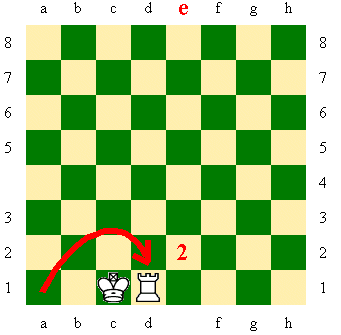 |
Step 2: That’s right. The queenside rook (which can be called the ‘queen rook’) moves to the opposite side of the king to sit on the square right next to it. |
The Rules for Castling
Basically, that’s it. Basically…. Yes, there are some other
rules to castling that control not so much as how you can castle, but whether if
you can castle at all or not. (Yeah, I know, there are always rules….) We’ll go
over them here:
Rule 1: The King Cannot Have Moved
Rule 1: If Here, for some reason that only he knows, white just So, if you want to castle, don’t move your king |


Rule 2: The Rook Cannot Have Moved
Okay, we can’t move the king before castling, how about the
rooks?
Rule 2: If In this position, white moved his king rook from square But all is not lost. Because the king has not yet moved, So if you can’t get your opponent to move his king early |
Now, even if you haven’t moved your king and rooks yet, there
still might be reasons why you can’t castle:
Rules 3 and 4: You Cannot Castle While in Check or Into Check
Rule 3: You (Sorry, they just didn’t think it was very Here, black has just moved his bishop to square ‘b4’ and Rule 4: You cannot And let’s look at black’s castling chances. Here, black |


Rule 5: You Cannot Castle Through Check
And there’s one more consideration to when you can and can’t
castle:
Rule 5: Huh? Okay, what I mean is that if the castling move It’s easier to visualize than describe. Here, white Similarly, black cannot castle kingside in this |

Can You Castle More Than Once?
Oh, by the way, there’s one more thing. If you’ve castled once
already, and just happen to get your king back to its original square later on
in the game, don’t think that you can castle again with the other rook that’s
still sitting on its own square on the other side of the board. You can’t.
Sorry. One per customer per game, please.
Practice Castling
So, that’s castling. The move itself is simple, and there’s
some additional rules that control it. As you play more games, you’ll get the
hang of it to where it’ll be second nature.