-
Learning chess terms is easier when kids can see them in action. After reviewing the glossary, children can practice chess concepts with the Kid Chess App, which includes guided lessons, puzzles, activities, and games designed for young players.
Active Piece
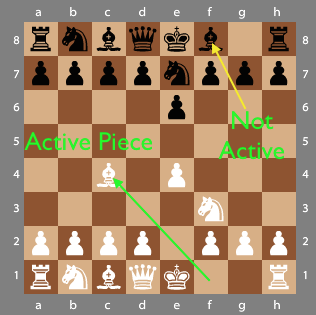
A piece that has free range of the board. The White Bishop on c4 is active; the Black Bishop on f8 is not.
Activity
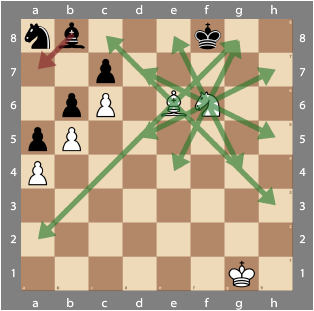
The freedom of movement, or mobility, that your pieces hopefully have.
In this position white’s bishop and knight have a lot of activity because hey have many squares they can move to. On the other hand, black’s knight and bishop are very inactive since they can go virtually nowhere.Attack
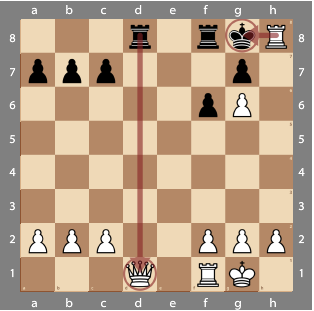
The process of going after your opponent’s king or vulnerability to win the game.
In this position black attacks white queen on d1 and white rook on h8 attacks the black king.Back Rank Mate
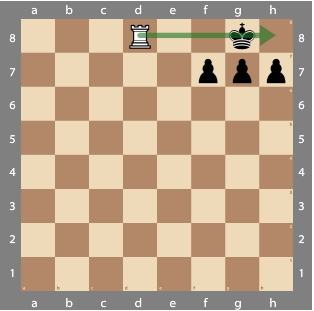
A checkmate that occurs when your opponent’s king is trapped behind a wall (usually a wall of his own pawns) on the back rank, and your queen or rook attacks on the back rank.
Backward Pawn
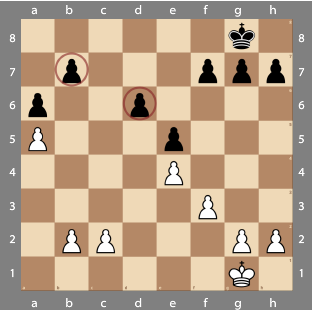
A pawn that has lagged behind and cannot be protected by other pawns. Usually considered a weakness.
Battery
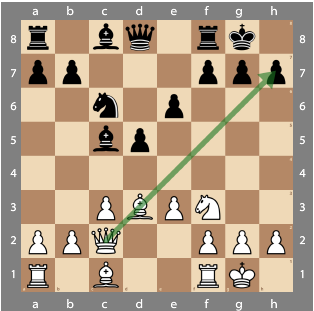
Two long range pieces (such as a queen and bishop) lined up and pointed in the same direction along a rank, file, or diagonal.
Bishop Pair
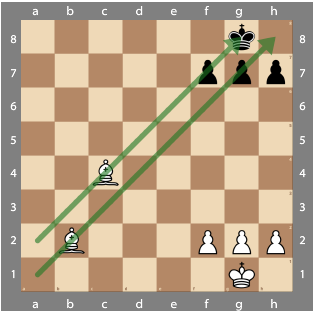
Because one bishop can cover the dark and the other the light squares they work well together as a pair.
Block
Placing a usually lesser-valued piece in front of a more-valuable one to block its capture by your opponent. Typically used more than not to get your king out of check.
Blockade
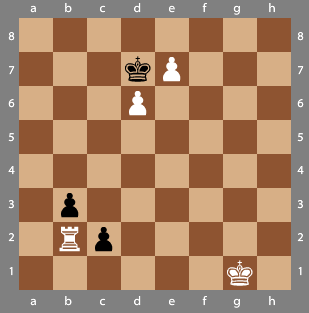
The act of placing a piece in the path of a “passed pawn” to keep it from promoting.
Black king successfully blocks both white connected passed pawns. White rook blocks only one pawn (b2), the other one will promote.Blunder
A really bad move.
Castling
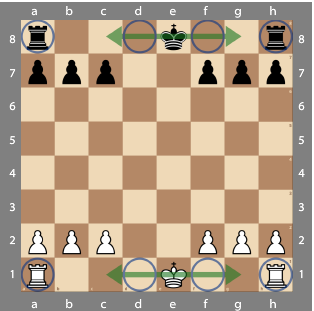
Castling consists of moving the king two squares towards a rook on the player’s first rank, then moving the rook to the square that the king crossed. Castling may be done only if the king has never moved, the rook involved has never moved, the squares between the king and the rook involved are unoccupied, the king is not in check, and the king does not cross over or end on a square attacked by an enemy piece.
Center
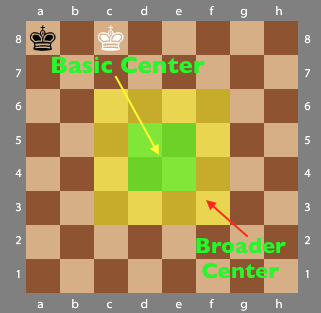
The squares d4, e4, d5, and e5. (Diagram) Basic center (4 green squares) broader center (16 yellow squares)
Centralize
To place pieces and pawns so they attack the center.
Check
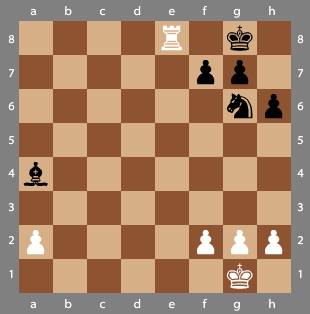
To directly attack or threaten to capture your opponent’s king. Your opponent must then immediately drop whatever he was doing to fix the problem.
Black’s king is in check now. To save the king black can either Capture the checking piece Bxe8 (the best option), Block the check Nf8, or Run away with Kh7.Checkmate
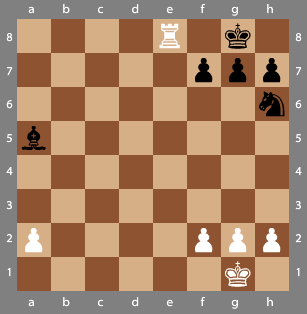
To “check” your opponent’s king with no way for it to get out of check. That is, they cannot capture the attacking piece, they cannot block the attack with another of their own pieces, and they cannot move the king out of check. “Checkmate” ends the game.
Here, black is checkmated. There is no way to Capture the white rook on e8, Block the check or Run away with the king. As the king is trapped behind a wall of it’s own pawns, this is in fact also called a Back Rank Checkmate.Closed Game
A position with few, if any, pawn trades where pieces are somewhat restricted in their movement.
Colle (Opening System)
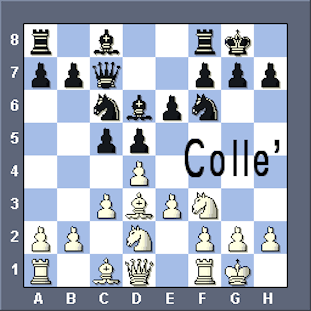
Opening piece formation for white arising out of moving the queen pawn instead of the king pawn.
Combination
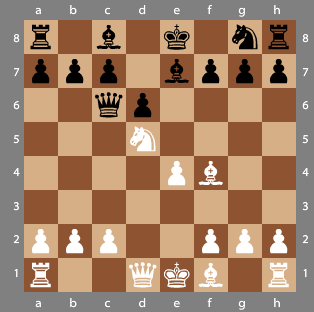
Series of tactical moves designed to improve your overall position, usually involving surprise and maybe even a piece “sacrifice”. In this position Bb5! starts a short (2-move) combination for white. The black queen is pinned, so black captures the unprotected bishop Qxb5. Now white forks black king, queen and rook with Nxc7+.
Connected Passed Pawns
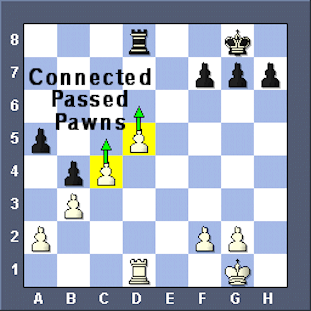
Two or more passed pawns of the same color that are on files next to each other.
Development
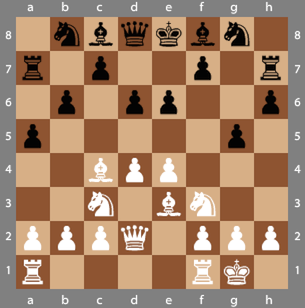
Development: The process of bringing your pieces into play and getting them active in the opening to get ready for the middle game.
In this position white has developed all of their minor pieces and castled the king. Black has been moving their pawns and rooks. White has a big advantage now.Discovered Attack
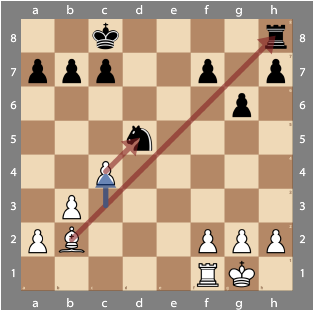
A chess tactic, when a piece moves to reveal an attack from previously hidden long range piece (i.e. bishop, rook or queen).
In this position white just moved the pawn from c3 to c4, attacking the knight and revealing a discovered attack on the black rook.Discovered Check
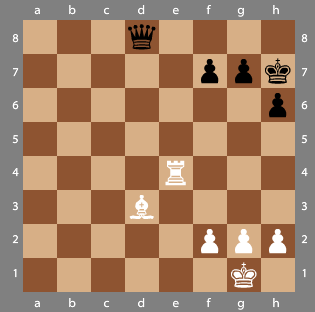
A special kind of discovered attack, when the hidden long range piece checks the king.
In this position, white plays 1. Rd4+, exposing the king to check from the bishop on d3 and attacking the black queen at the same time. Black must get their king out of check and white takes the queen next move. Note that 1. Re8+ would not work as black would simply respond 1…Qxd3 capturing the checking bishop.Double Attack
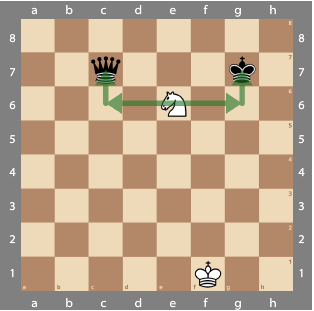
A move that attacks two things at once.
In this diagram the knight on e6 attacks both the black queen and king.Double Check
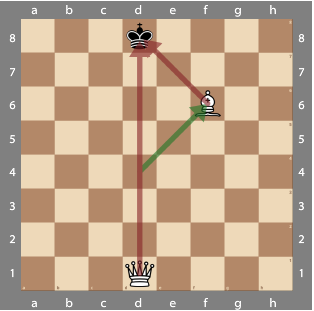
A special kind of discovered attack/discovered check, when both pieces attack the opponent’s king at once. Double checks are super-powerful, because they cannot be stopped by capturing or blocking either piece.
In this position white has just moved the bishop from d4 to f6, discovering an attack from the queen and moving the bishop to a square where it is also checking the king.Doubled Pawns
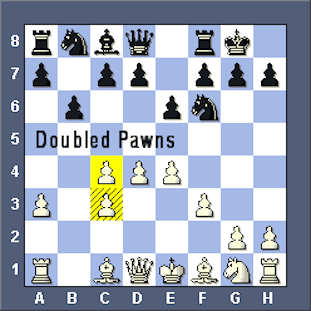
Tend to be a weakness.
Dragon (Opening System)
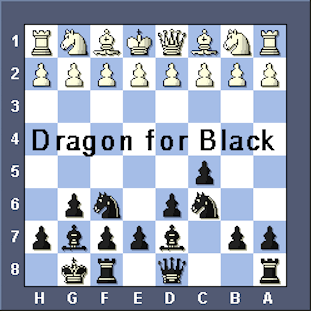
An opening piece formation for black based on the Sicilian Defense.
Draw
End of the game where neither side wins and neither side loses.
Dual Purpose Move
A move that accomplishes two ore more things.
En Passant
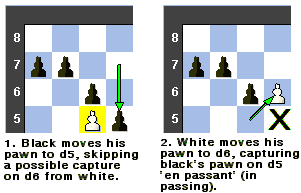
French term (meaning “in passing”) for a special capture move between two pawns. A pawn which on its first move advances two squares and passes an enemy pawn on an adjacent file that has advanced to its 5th rank, may be captured by that enemy pawn as if the first pawn had moved only one square.
Endgame
Late in the game when there are relatively few pieces left on the board.
Exchange
A trade or swap of pieces.
The Exchange
Expressing the difference in piece value between a rook and your opponent’s bishop or knight. Gaining a rook for your own bishop or knight is called “winning the exchange”.
Fianchetto
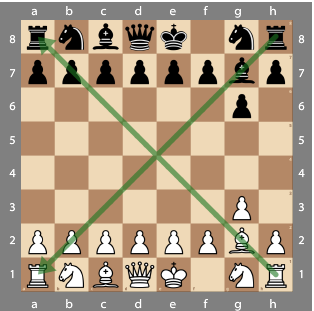
Pronounced “fee-an-KETT-toe”.When you develop your bishops to b2, g2, b7, or g7. A necessary part of building a “house”.
File
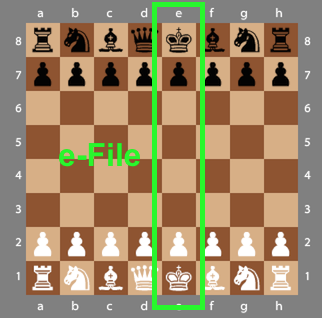
A row of eight vertical squares.
Forced Move
A move that is the only one to not result in a serious disadvantage for the moving player.
Fork
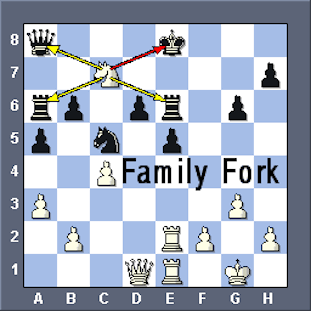
Situation when a piece or pawn attacks two or more of your opponent’s pieces at the same time.
Gambit
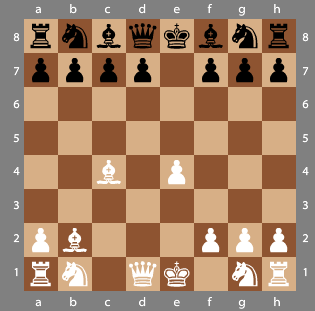
A pawn sacrifice made in the opening to gain the initiative or advantage in development.
Hanging
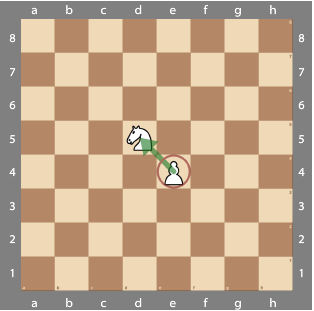
An unprotected piece or pawn.
In this position white knight on d5 is protected by the pawn. However the pawn is hanging because it is not protected by anything.Hole
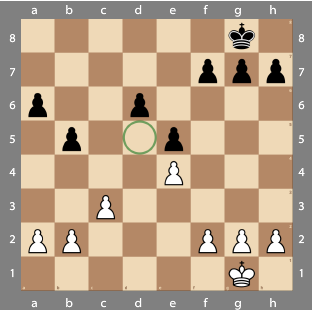
A square that cannot be defended by pawns.
House
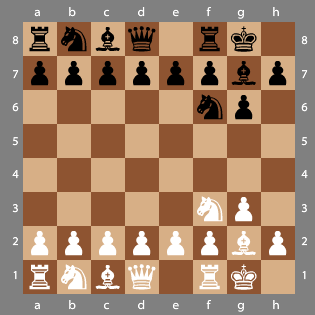
The kingside formation of a centrally-developed knight, fianchettoed bishop, and castled king.
In-between Move
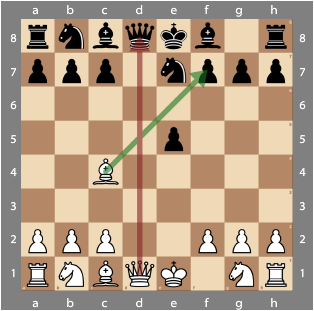
(Also known as “zwischenzug” or “intermezzo”.) A tactic in which a player under threat, instead of directly countering, introduces an even more devastating threat. The tactic often involves a new attack against the opponent’s queen or king. The opponent then may be forced to address the new threat, abandoning the earlier attack.
In this position it is white’s move and they will play the in-between-move 1.Bxf7+. This forces black to capture the bishop with 1…Kxf7, and white will follow with 2.Qxd8 winning the black queen.In Your Face Checkmate
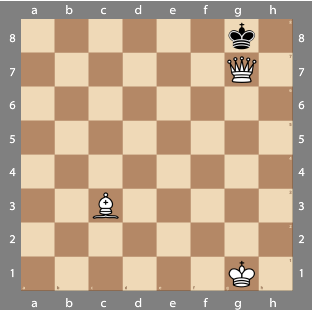
A checkmate when the checkmating piece (usually a queen), supported by another piece is next to the opponent king.
Initiative
When you have an advantage in time and space, while your opponent is on the defensive.
Insufficient Mating Material
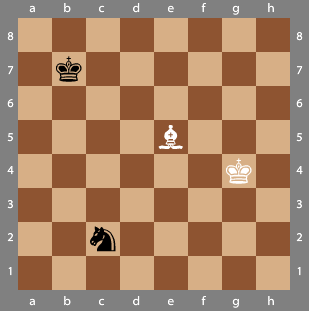
A type of draw, when neither side can ever checkmate the opponent. King vs King, King & Knight vs King, King & Bishop vs King, and even King & two Knights vs King are insufficient.
Isolated Pawn
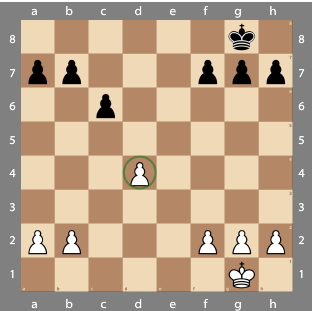
A pawn with no friendly pawns next to it on adjoining files.
In this position white has an isolated pawn on d4, while black has no isolated pawns.Kingside
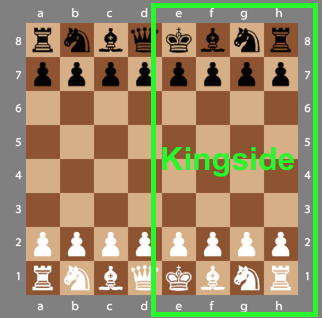
The e-h files. This is the right half of the board for White and the left half of the board for Black. This is the side where both Kings and their Bishops, Knights, and Rooks next to them initially start. Compare to ‘queenside’.
Major Pieces
As in the Queen and Rooks. Also called Heavy Pieces.
Maneuver
A quiet redeployment of pieces to a hopefully better position.
Mate
Short for “Checkmate”.
Material
Any or all of your pieces and pawns, except the king. Both sides have equal material, even if their forces are different. Pawns = 1, Knights & Bishops = 3, Rooks = 5, and Queens =9.
Middlegame
The part of the game that comes after the Opening and before the endgame, where both sides seek advantage. Arrived at upon completion of development of back-row pieces.
Minor Pieces
Name given to the bishops and knights.
Octopus
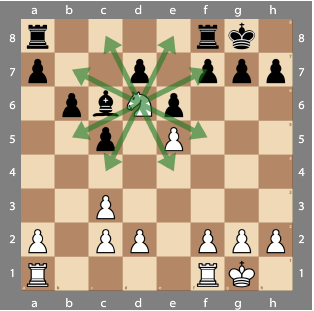
A Knight on an advanced outpost. Oftentimes the 6th rank.
Open File
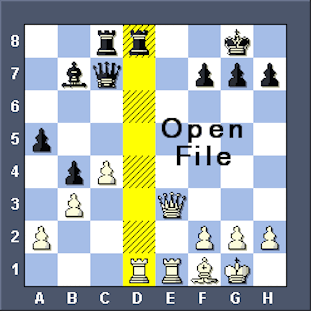
A vertical row of 8 squares containing no pawns. Rooks typically should move to open files.
Open Game
A position where pieces can move freely (usually because some pawns have been exchanged), with the possibility of sudden attacks or combinations.
Opening
Known sequence of moves, usually published in a chess book. The Sicilian and The Colle’ are examples of openings.
Outpost
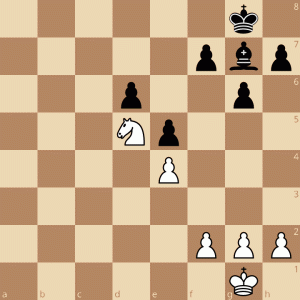
Outposts are squares with a Knight, Bishop, and sometimes Rook defended by a Pawn. To be an Outpost, the square cannot become attacked by an opponent’s Pawn, nor can it be attacked easily by a piece of equal or lesser value. The closer the Outpost is to the opponent’s back rank, the more advanced and powerful the piece on the Outpost tends to be. In the above example, White’s Knight is on an outpost, absolutely safe from capture by any of Black’s Pawns.
Overloaded Pieces
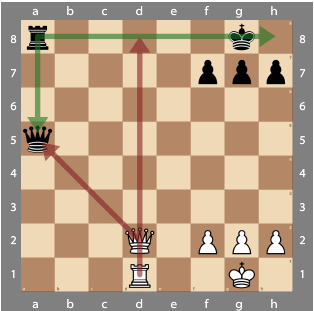
A piece that is doing too much.
In this position it is white’s move and black’s rook on a8 is overloaded. It cannot both protect the queen on a5 and the back rank successfully. If white plays 1.Qxa5 black cannot re-capture 1…Rxa5 for fear of checkmate by 2.Rd8#.Overprotection
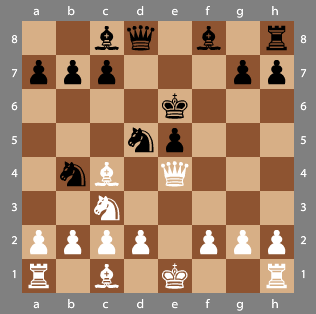
Grandmaster Aaron Nimzovich’s term for giving a piece or square more protection from your pieces or pawns than is immediately needed to guard it.
In this position in Fried Liver Attack white has three pieces attacking pinned black knight on d5, while black has three defenders. However black chooses to overprotect this knight with 1…c6.Passed Pawns
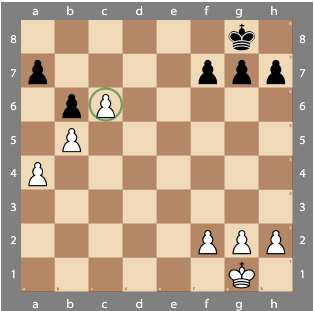
A pawn that has moved beyond capture by the other side’s pawns and has no other pawns in front of it.
Pawn Break
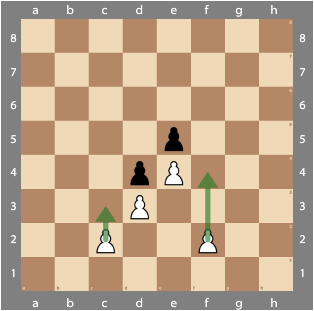
A move that invites the exchange of pawns to open the position.
In the example, the pawn on c2 moving to c3, or the one on f2 moving to f4 would both be pawn-breaks. However, the moves 1.c4 or 1.f3 would not be pawn-breaks.Pawn Chain
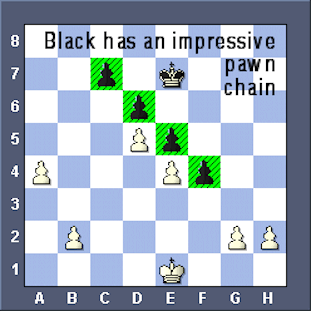
Two or more pawns of the same color linked together diagonally.
Pawn Island
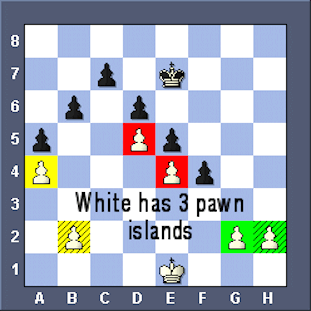
A group of pawns separated from other pawns of the same color. It is generally hard to defend a lot of pawn islands.
Pawn Structure
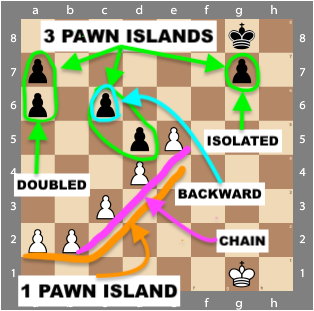
The overall position of the pawns in any particular moment of a game of chess.
In the example shown, white has an excellent pawn structure, with only one pawn island and a strong, central, pawn-chain. Black’s pawns structure, on the other hand, is quite bad, with three pawn islands, doubled pawns, a backward pawn, and and isolated pawn.Perpetual Check
A position where one player can force the opposing side to repeat the same positions over and over again by checking their king on every move giving them limited options.
Pigs on the Seventh
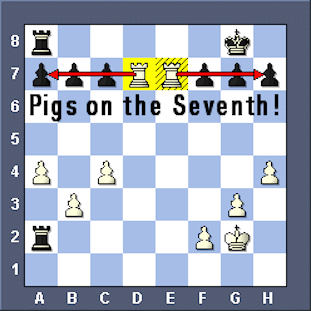
Two rooks acting together on the 7th rank. “Pigs on the 7th” typically gobble up all of your opponent’s pawns on that rank.
Pin
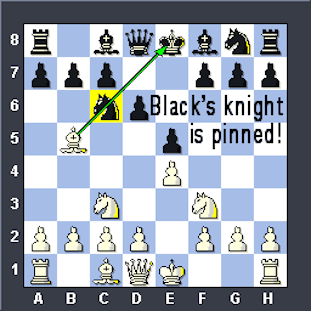
When a piece cannot move without exposing a higher-valued piece to immediate capture, that piece is said to be “pinned”.
Poisoned Pawn
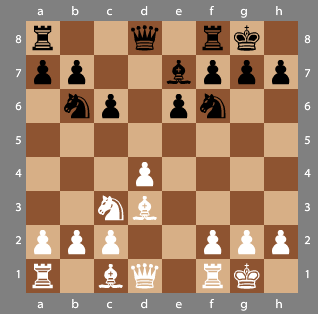
Any pawn that appears to be free for the taking but which will set off a trap against you if you do.
White pawn on d4 is poisoned. If black plays Qxd4 white replies with Bxh7+, discovering the attack on the black queen.Positional
Quiet, fundamentally sound moves that don’t create weaknesses.
Promotion
Making a new queen or other piece when a pawn reaches the 8th rank.
Protected Passed Pawn
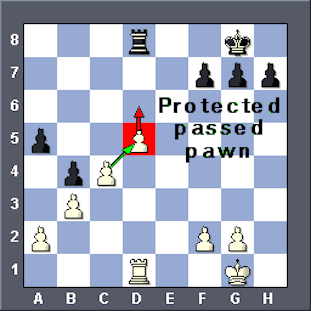
A passed pawn that is protected by a friendly pawn.
Queenside
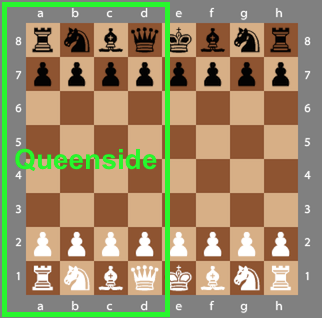
The a-d files. The left half of the board for White and the right half of the board for Black. This is where both Queens and their Bishops, Knights, and Rooks next to them initially start.
Rank
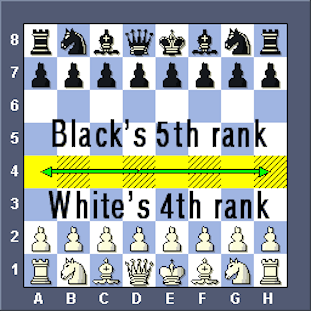
A row of eight horizontal squares.
Rating
A number that comes from a formula devised by Dr. Arpad Elo which indicates a player’s strength, based on his or her win-loss record against other rated players.
Removing the Defender
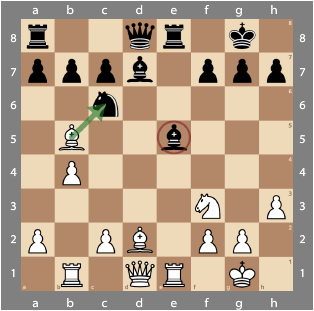
A move (often a capture) which removes an enemy defender of another enemy square or piece.
In the position, white is threatening to play 1.Bxc6, removing one of the two black defenders of the black bishop on e5 and leaving it available for capture. 1.Bxc6 Bxc6 2.Nxe5 (if 2…Rxe5, white plays 3.Rxe5 and wins even more material)Resign
To concede defeat before being checkmated.
Sacrifice
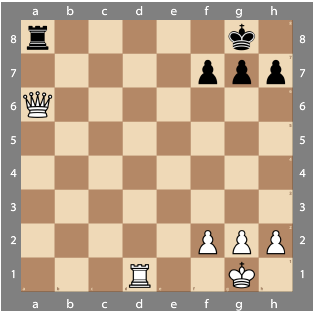
(May be abbreviated to and called “sac”.) To give up a piece or to exchange a piece for a lesser-valued opponent’s piece in order to gain a positional or tactical advantage. In this position white is happy to sacrifice their queen on a6 to 1…Rxa6 because they will follow up with checkmate, 2.Rd7#.
Scholar’s Mate
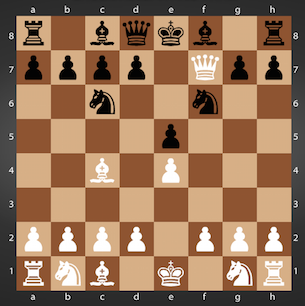
A very aggressive although speculative opening for white with an early queen and bishop attack on f7. If black blunders, the game ends on move 4, thus alternative name “4-move mate”. 1. e4 e5 2. Qh5 Nc6 3. Bc4 Nf6?? 4. Qxf7# White can play this opening transposing moves 2 and 3.
Skewer
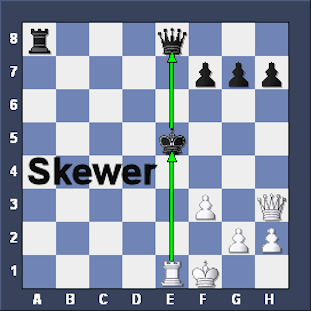
A tactic where you attack two of your opponent’s pieces at the same time along a rank, file, or diagonal, and the more-valuable piece is attacked first.
Space
Space is the amount of squares that a player’s pawns and pieces control on the board. A player who controls more squares has a space advantage which gives their pieces more room to maneuver and restricts the opponent’s pieces at the same time. Gaining more space is getting more squares under control usually via advancing pawns into the opponent’s territory or with the help of the pieces, which can control several key squares in the opponent’s side, keeping them restricted.
Stalemate
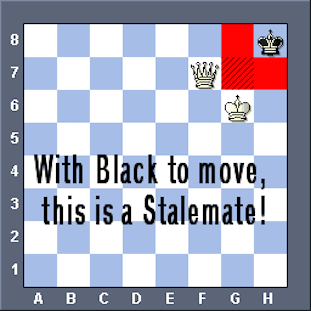
Position where a player “on move” is not in “check”, but also has no legal move. Such a game is considered to be a “draw”.
Starting Position
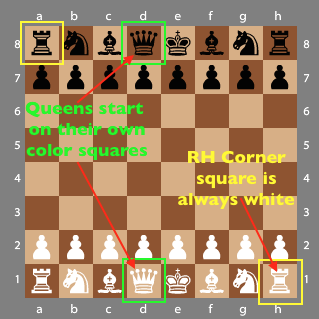
The initial setup for all the pieces and pawns at the beginning of a chess game.
Strategy
Your long range master plan. The main idea behind your moves, which guides your thinking during the game.
Symmetry
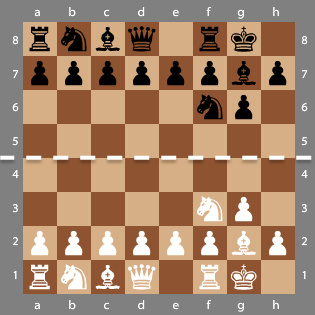
When you copy your opponent’s moves or they copy yours in the opening. That is, a position where both sides are arranged the same. Example as shown in the diagram: 1. Nf3 Nf6, 2. g3 g6, 3. Bg2 Bg7, 4. O-O O-O arrives at a symmetrical position. “Copycatting” usually doesn’t work, by the way, as your plans to copy everything your opponent does gets blown out of the water by the first check to your king!
Tactics
A sequence of moves that limits the opponent’s options and may result in sufficient gain. There are many kinds of tactics, see fork, pin, skewer, discovered attack, battery, remove-the-defender etc.
Tempo
(Latin for “time”.) Amount of relative time represented by a single move.
Time Control
The amount of time you have on your clock to either complete your game or make a given number of moves. Exceeding the time control means you lose the game.
Trap
Provoking your opponent to make a really bad move that looks appealing for them often to capture material. See also Poisoned Pawn.
Trapped Piece
A piece that has no escape from capture by the enemy.
Underpromotion
When promoting a pawn to something other than a queen.
Weakness
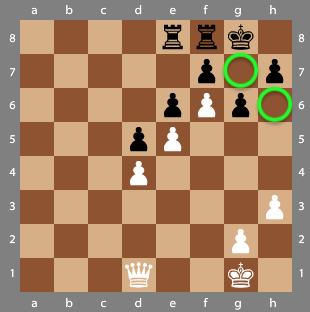
A square or pawn that is difficult or impossible to defend. The dark squares around black king g7 and h6 are weak (aka holes). White has already placed their pawn on f6. The plan is to bring white queen to h6, after that the checkmate on g7 is unstoppable. The fastest maneuver is 1.Qd2/Qc1 followed by 2. Qh6.
Windmill Attack
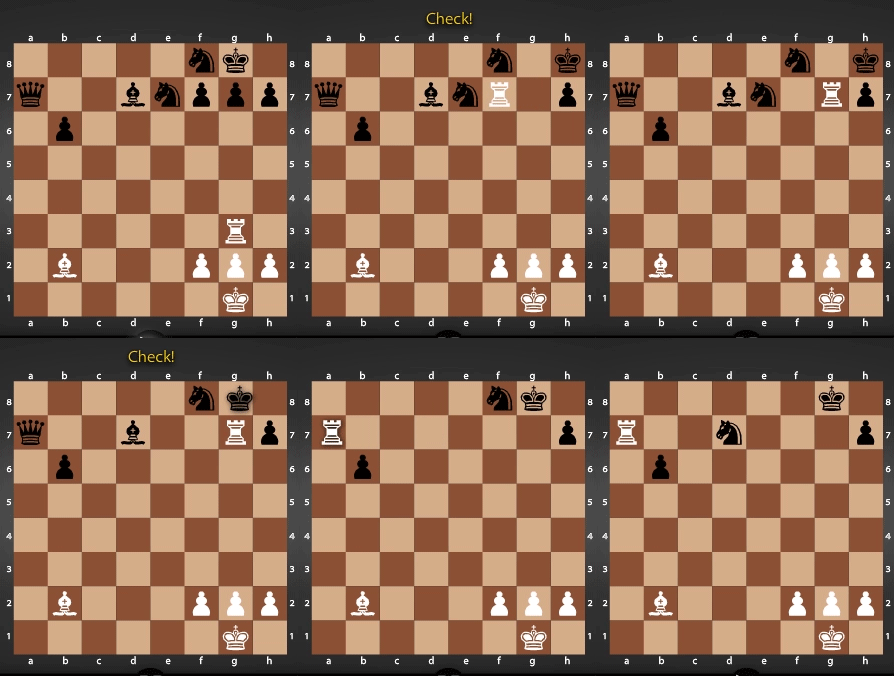
A tactic in which a combination of discovered checks and regular checks against a castled king’s position, usually by a rook and a bishop, can win massive amounts of material.
X-ray Attack
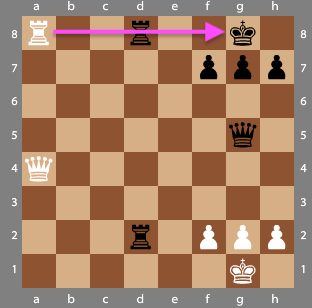
A tactic where a piece attacks an enemy piece through another piece or pieces. White back rank checkmates in this position. After 1.Qe8+!, the White rook X-ray attacks e8 and therefore backs up the queen, so after 1…Rxe8, 2.Rxe8#
Zugzwang
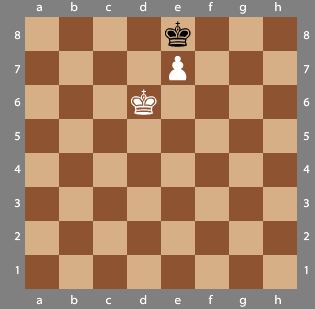
(German for “compulsion to move”.) A situation that occurs when a player is forced to make an undesirable move. The player would prefer to pass and make no move, but a move has to be made.
This seemingly-simple position shown here is drawn, if white is to move. White’s king has to either move to e6 with a stalemate or abandon their advanced passed pawn. But if it is black’s turn, they must move their king 1…Kf7, at which point 2.Kd7 and white pawn promotes to a queen.

- Home
- Our Programs
- -- Kid Chess® For Your School
- -- Kid Chess® After School Chess Programs
- -- Seasonal Camps
- -- Tournaments and Events
- -- Private Lessons Online
- -- Chess.Zone ⇗
- Learn to Play
- -- Kid Chess App
- -- Setting Up
- -- Look First, Move Later!
- -- Glossary of Chess Terms
- About Us
- -- Meet the Team
- -- Kid Chess News
- -- Why Chess Makes You Smart
- -- AJC Article About Kid Chess®
- Careers
- Contact Us